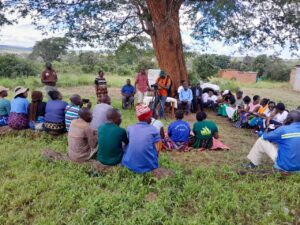
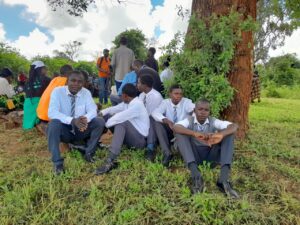
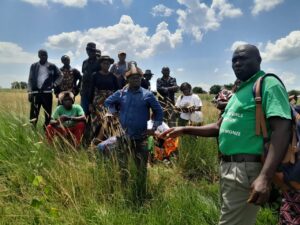
Late in February, a group of farmers, extension officers, civil society organisations, and government representatives gathered in Monze for three days of farmer-to-farmer learning, as well as a living demonstration of how partnerships that are based in trust, shared learning, and collective action can transform communities and build lasting resilience.
The farmer innovation platform, organised by the Regional Schools and Colleges Permaculture (ReSCOPE), in collaboration with the Tweende initiative (a collaboration between the Zambia Alliance for Agroecology and Biodiversity, Grassroots Trust and Mulungushi University), brought together participants from across the country to learn from four years of agroecology work in Hanamoonga Village, as well as the very effective land and livestock management practices of Itebe.
The story of agroecology in Hanamoonga began four years ago when the late Mr Conard Hanyanga, a respected community leader, approached ReSCOPE with a pressing concern: wells and boreholes were drying up, crop yields were declining, and his community was losing its ability to sustain itself. Far from being a distant threat, climate change was at their doorstep.
ReSCOPE, with its expertise in permaculture and sustainable agriculture, joined the community, and together, they began to experiment with water harvesting swales, intercropping, check dams, and dry toilets. The journey was slow at first, with many sceptical of the new methods, but a group of young people saw the opportunity early on and embraced the vision.
“We are inspired to work by our problems,” said Cosmas Hanyanga, a young farmer who took up his uncle’s vision and now leads much of the work in Hanamoonga. “For years we’ve seen our mothers carrying heavy buckets of water for long distances. So we dig dams out of necessity, and our problems have made us strong.”
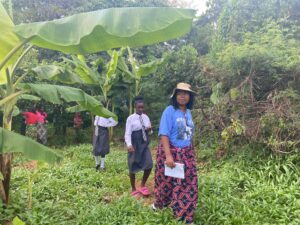
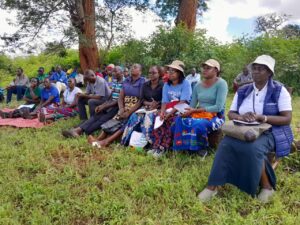
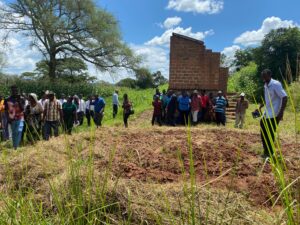
By the time of our visit, walking through Hanamoonga tells an entirely different story. Fields, once parched, now retain moisture through carefully constructed swales covered in grass and cassava. The Hanambaka stream, which used to dry up quickly after the rains, now flows longer thanks to check dams that slow runoff and recharge groundwater. And, perhaps most excitingly, farmers like Elector Simoonga and Gladys Muteza have become teachers themselves, showing visitors how they have improved their yields while reducing their dependence on expensive inputs.
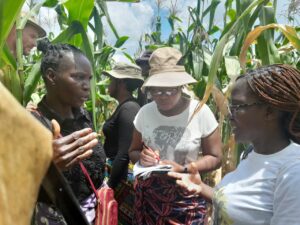
That is the beauty in farmer-to-farmer knowledge exchanges. Instead of relying on just external input, farmers learn directly from one another through demonstrations, field visits, and community discussions. This peer-to-peer model, deeply rooted in the principles of agroecology, proved to be the most effective learning tool on this field trip as well. At Elector’s farm, visitors learned about Azolla, a fast-growing plant that serves as nutrient-rich livestock feed and biofertiliser, and how to grow it. At Gladys’ field, they saw intercropping in action: maize, groundnuts, and pumpkins growing together, each playing a specific role in supporting the others. At Cosmas’ farm, we examined a dry toilet that converts human waste into safe, organic fertiliser, closing the nutrient loop in a way that synthetic inputs can’t. Also very powerful was the exchange of information in the discussions that followed. Farmers asked farmers questions: How do we convince our neighbours to try these methods? How do we get youth interested? How soon can we see the results, and how do we keep from losing hope? The answers came not from manuals, but from lived experience.
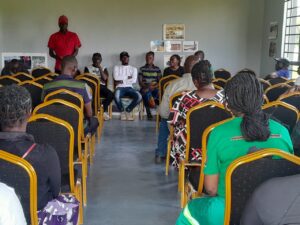
On the second day of the platform, the conversation shifted from the field to the policy table. Here, the value of partnerships across sectors became evident as representatives from the District Agricultural Coordinator’s Office sat alongside farmers from Hanamoonga, Mpanshya, and Kasenengwa, CSOs, activists, teachers, and youth to further learn about each other’s work and unpack some of the most pressing policy issues facing Zambian farmers today.
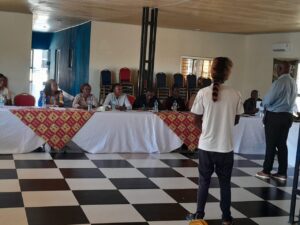
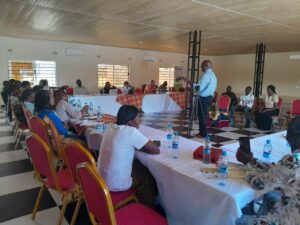
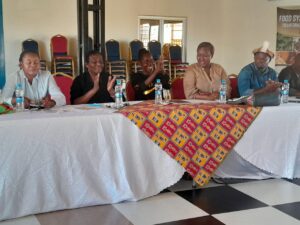
Maureen Sichinga, a farmer and farmers’ rights advocate, delivered a sobering presentation on the proposed Plant Breeders’ Rights Bill and its alignment with the UPOV 1991 convention. She explained how the bill threatens to criminalise the traditional practice of saving, exchanging, and selling farm-saved seeds.
“As a country, we must fight for our food sovereignty by ensuring we say no to UPOV,” she told the room, with the conviction of someone who knows what is at stake.
Mwabi Jere, an advocacy campaign consultant, followed by connecting these local concerns to national policy processes, presenting on Zambia’s revision of its National Biodiversity Strategy and Action Plan (NBSAP III). She emphasised that agroecology is explicitly referenced in the Global Biodiversity Framework (Target 10) and that Zambia has committed to reducing pollution from pesticides by 70% by 2030 under its own targets. The question is not whether these commitments exist, but rather how we can ensure that they are implemented.
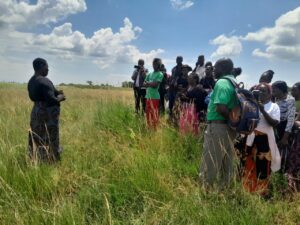
The final day of the platform took participants to Itebe in Mazabuka District, where the theme of partnership is embodied in the relationship between the local community, Solidaridad and Tweende, represented on the ground by ZAAB, Grassroots Trust and Mulungushi University. Farmers Cabinet Mungala, Fanwell Lwiindi and Iredy Munyati led us through their fields, demonstrating Kutulisa, a traditional shifting kraal practice originally developed by the Lozi people of Western Province. By moving livestock kraals periodically, manure and urine accumulate on the soil, naturally enriching it. A side-by-side comparison in research conducted by Tweende showed that fields treated with this method achieved crop yields similar to those using synthetic fertiliser!
The community has also adopted rotational grazing, dividing grazing land into sections and moving animals systematically to allow pasture to regenerate. They have established bylaws with penalties for unauthorised grazing, burning, or charcoal production, and as a result, approximately 150,000 hectares of land are now under sustainable land management, with improved calving rates of up to 80% in some areas.
Also exciting is the community market, built with Solidaridad’s support. Here, farmers sell their produce, use a spray race to control ticks with organic pesticides, and process cowhide into genuine leather products like bags and belts – a value addition that allows farmers to earn income beyond meat and milk and creates opportunities for youth.
What emerged very clearly from this farmer innovation platform are lessons about the power of partnerships and learning exchanges.
- The work in Hanamoonga began with a community leader reaching out for help. It grew because ReSCOPE listened, walked alongside the community, and honoured local knowledge. Partnerships built on trust can weather scepticism and setbacks.
- The most effective learning happens in a field, with one farmer showing another what works. This peer-to-peer model is scalable, cost-effective, and builds lasting networks of mutual support.
- Policy change requires sustained engagement. A seat at the table is not enough. Civil society must show up consistently, present evidence, build relationships, and advocate with one voice. The NBSAP revision process, the National Agroecology Strategy, and the second National Agricultural Policy consultations are all opportunities to shape the future of Zambian agriculture together.
- We are stronger when we walk together. No single organisation could have achieved what this network has. From providing permaculture expertise, connecting grassroots practice to policy advocacy, and contributing to livestock management and market development, to supporting field schools and providing research capacity, we all have something to offer to the journey.
The work is far from finished. The threat of the UPOV-aligned PBR bill, the unchecked popularity of highly hazardous pesticides, the contradictions in government policy, and the urgent need to engage youth in agriculture – the challenges remain daunting. But the partnerships created in these spaces provide a model for how we can meet these challenges together.