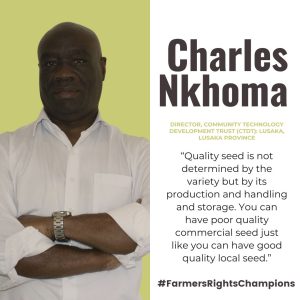
Charles Nkhoma’s journey in agriculture began in 1982, following his graduation from UNZA with a BSc. Degree in agriculture. He joined the Zambia Agriculture Research Institute (ZARI) as a weed control agronomist, but his role quickly expanded to encompass curatorship due to staffing constraints. This pivotal moment ignited his passion for plant taxonomy and propelled him towards an in-depth understanding of botanical identification, including mastering the nomenclature of farmers,plant species.
Charles soon found himself escorting international germplasm collectors across Zambia, making intimate ties with farmers and learning critical lessons about seed diversity. He pursued further education, earning a Masters Degree in Conservation and Utilisation of Plant Genetic Resources in the United Kingdom alongside Godfrey Mwila. When they returned, they founded Zambia’s national genebank and eventually contributed their expertise to the SADC genebank. Following a spell at WWF, Charles founded the Community Technology Development Trust (CTDT) to bridge the gap between farmers and genetic resource preservation efforts. His objective was to get farmers involved in genetic resource protection. CTDT now works directly with farmers to enhance their livelihoods by leveraging the diversity of locally accessible food plants.
How do you believe the proposed changes to the Zambian seed laws will impact farmers, especially those in remote or marginalised areas?
The planned modifications primarily target the formal seed system while ignoring the farmer-managed seed system (FMSS), which is critical for smallholder farmers. While organisations such as CTDT advocate for the acknowledgment of local seeds, there is concern that the amended regulations would further restrict farmers’ rights to store, reuse, and share seeds, particularly in order to comply with UPOV 1991 criteria. To effectively support farmers, we must maintain current rules and develop methods to incorporate them into the seed system.
What are the key challenges that Zambian farmers currently face regarding access to seeds, and do you think the proposed changes address these challenges?
The major challenge lies in the lack of recognition and investment in local seeds, which are vital for agriculture production. The proposed changes fail to address this issue adequately. However, initiatives like the CTDT-proposed farmer variety registration system present a promising solution. By formally recognising local seeds, we can increase their availability and accessibility, leading to improved seed sovereignty for farmers.
How do you envision the role of local communities and small-scale farmers in shaping agricultural policies, particularly those related to seed laws?
Local communities and small-scale farmers represent the majority of Zambia’s population and can influence policy by organising and making demands of the government. However, they need support in building their capacity for advocacy and negotiation. Civil society organisations play a crucial role in empowering farmers and facilitating their engagement in policy-making processes.
Can you share a specific experience or example that highlights the importance of preserving traditional seed varieties in Zambia?
Climate change has shown the importance of preserving traditional seed varieties. Formal varieties often struggle in adverse conditions, while local seeds exhibit resilience and adaptability. The diversity within local seeds serves as a safeguard against crop failure and contributes to food security during challenging times.
What strategies do you think could be effective in ensuring that the proposed changes lead to positive outcomes for both farmers and the agricultural sector as a whole?
Initiatives like farmer variety registration and participatory research can enhance the availability and quality of local seeds. Increased farmer participation in seed production and marketing will improve livelihoods and contribute to nutrition. Recognising and supporting local seeds will also promote environmental sustainability through diversified cropping systems.
How can the government, NGOs, and the private sector collaborate to ensure that these changes promote inclusivity and benefit all stakeholders in the agricultural value chain?
Collaboration is key to ensuring inclusive seed laws. Once changes to include local seeds are adopted, the government can collaborate with farmers on research and development initiatives. NGOs can facilitate linkages between farmer seed enterprises and the private sector, leading to improved seed production and market access for farmers.
Are there any success stories or best practices from other regions that you think Zambia can learn from in implementing seed law reforms?
Many countries are reforming their seed laws to include local seeds and address environmental concerns. Zambia can learn from India’s approach, which provides for both formal and informal seed systems, allowing consumers to choose based on their needs. Additionally, Europe’s focus on increasing quotas for local seed production offers valuable insights into promoting environmental sustainability.