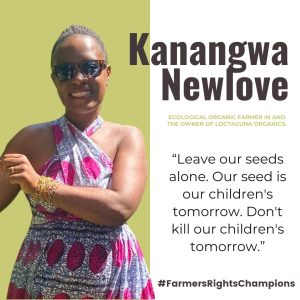
The visionary CEO of Loctaguna Organics, Kanangwa Newlove is more than just a farmer. She’s a bridge between local farmers and the food service community, tirelessly working to create a sustainable and organic food system. Witnessing her passion and dedication firsthand at Loctaguna Organics is an inspiring experience.
Through her partnership with the Kasisi Agricultural Training Centre, she empowers small-scale farmers across Zambia by training them in agroecological methods. This not only puts organic farming on the map but also revitalises awareness of healthy eating habits and responsible farming practices. Newlove doesn’t stop at education. She actively connects farmers, eaters, and businesses that prioritise local and responsible sourcing, both within Zambia and internationally. Her ultimate goal? To strengthen the entire food community, not just in Zambia but beyond.
Kanangwa’s journey with agriculture began after a decade-long career in business and marketing. Armed with a Bachelor of Arts degree from the University of Zambia, she transitioned into ecological organic farming and established Loctaguna Organics. Her passion for sustainable food systems also led Kanangwa to take part in the IFOAM – Organics International’s Ecological Organic Agriculture Leadership Course in 2021, and she’s since been actively involved in promoting agroecological agriculture through speaking engagements and workshops.
How do you believe the proposed changes to the Zambian seed laws will impact farmers, especially those in remote or marginalised areas?
Any restriction on a farmer’s freedom to choose and utilise seeds is unjust. These proposed changes could disproportionately affect farmers in remote or marginalised areas, limiting their access to diverse seed varieties and undermining their autonomy in agricultural practices.
What are the key challenges that Zambian farmers currently face regarding access to seeds, and do you think the proposed changes address these challenges?
One major challenge is the lack of heirloom seeds available on the market, with most seeds being hybrids treated with harmful chemicals. Additionally, the high cost of seeds further exacerbates the issue, making them unaffordable for smallholder farmers. The proposed changes do not adequately address these challenges, and efforts should focus on ensuring the availability of affordable and chemical-free seeds for all farmers.
How do you envision the role of local communities and small-scale farmers in shaping agricultural policies, particularly those related to seed laws?
Experience is invaluable, and small-scale farmers possess firsthand knowledge of seed management. They should play a significant role in policy-making processes, ensuring that policies are informed by practical insights from the ground.
Can you share a specific experience or example that highlights the importance of preserving traditional seed varieties in Zambia?
Preserving traditional seed varieties is not only essential but also practical. Personally, I’ve experienced the benefits of seed preservation, particularly with Amaranthus seeds, which have consistently served my farm’s needs for both consumption and animal feed. This underscores the value of preserving diverse seed varieties for sustainable agriculture.
What strategies do you think could be effective in ensuring that the proposed changes lead to positive outcomes for both farmers and the agricultural sector as a whole?
Prohibiting GMO seeds and promoting free seed exchange among farmers are crucial strategies for enhancing plant diversity and ensuring environmental sustainability. Additionally, facilitating dialogue among stakeholders, with smallholder farmers leading the discourse, is essential for inclusive and effective policy reforms.
How can the government, NGOs, and the private sector collaborate to ensure that these changes promote inclusivity and benefit all stakeholders in the agricultural value chain?
The voices of smallholder farmers must be central in collaborative efforts involving the government, NGOs, and the private sector. By prioritising dialogue and participation from grassroots levels, inclusive policies can be developed that benefit all stakeholders along the agricultural value chain.
Are there any success stories or best practices from other regions that you think Zambia can learn from in implementing seed law reforms?
Globally, there are examples of countries adopting inclusive seed laws that prioritize local seed systems and environmental sustainability. Zambia can draw inspiration from these approaches, particularly in facilitating seed exchange and preserving traditional seed varieties.