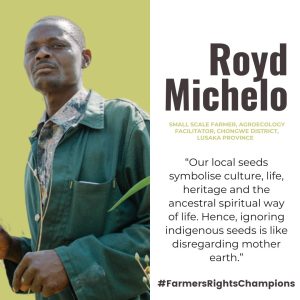
Royd Michelo, a small-scale farmer residing in Chongwe District under Chief Bunda Bunda, epitomises agroecological stewardship. With a multifaceted role as a facilitator, practitioner, and implementer of agroecological practices, Royd champions sustainable farming methods, including water harvesting, soil fertility management, and natural pest control. His innovative approaches encompass organic fertiliser and liquid bio-fertiliser production, feed fermentation, intercropping, livestock integration, and crop diversification, all aimed at building resilient farming communities.
Royd’s commitment to promoting seed and food sovereignty as tools for resilience has earned him recognition, including winning accolades at various agricultural shows and being celebrated by the Food and Agriculture Organisation Zambia as a community centre of excellence for nutrition scaling. Engaged with diverse agroecological partners, Royd serves as a part-time facilitator and contact farmer, contributing to initiatives led by organisations such as the Zambia Alliance for Agroecology and Biodiversity (ZAAB) and ActionAid Zambia. Recognised as a voice for sustainable food production, Royd has represented Zambia on international platforms, advocating for resilient agriculture amidst climate change challenges.
We spoke to the Farmers’ Rights Champion about his perspective on Zambia’s seed laws and the importance of local seed sovereignty.
What are the key challenges that Zambian farmers currently face regarding access to seeds, and do you think the proposed changes address these challenges?
Zambian farmers, especially those in remote areas, encounter difficulties in accessing affordable seeds. These challenges include limited availability and high costs, hindering farmers’ ability to secure the seeds they need for planting. The proposed changes offer promising solutions by promoting the sale of indigenous seeds alongside commercial varieties, making seeds more accessible and affordable for all farmers.
What strategies do you think could be effective in ensuring that the proposed changes lead to positive outcomes for both farmers and the agricultural sector as a whole?
To ensure positive outcomes, we need to implement several strategies. First, we should conduct community demonstrations across chiefdoms, districts, and provinces to raise awareness and encourage participation in seed production. Second, increasing sensitization through various media channels will help disseminate information effectively.
Third, organizing exchange visits among practitioners and innovators will facilitate knowledge sharing and adoption of best practices. Fourth, conducting training sessions for trainers will improve service delivery efficiency. Lastly, arranging international exchange visits will expose us to global practices and innovations, enhancing our agricultural capabilities.
Could you provide a personal statement expressing your thoughts and concerns about the proposed changes to Zambian seed laws?
My personal statement regarding the proposed changes to Zambian seed laws is rooted in recognition and respect for indigenous seeds. Indigenous seeds symbolise our culture, heritage, and ancestral way of life. They have sustained us for generations, offering resilience, biodiversity, and medicinal properties. By acknowledging indigenous seeds and promoting their use, we honour our connection to the land and ensure food security for future generations. Collaboration between the government, NGOs, and the private sector is essential to realising these changes and building a more sustainable agricultural future for Zambia.