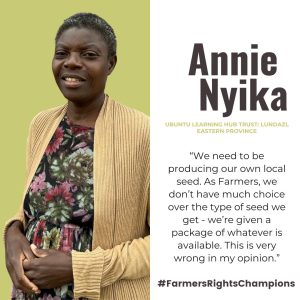
Annie Chikanji Nyika comes from a long line of Zambian farmers. Growing up in Chingola, she was immersed in the rich tradition of intercropping, where seeds were not just commodities but symbols of community exchange and resilience.
Annie exemplifies the spirit of grassroots farming and sustainable agricultural practices. Her dedication to preserving traditional farming methods and advocating for farmer autonomy has made her a respectable figure in Zambia’s smallholder farmer landscape. With a degree in Community Development as well as a Certificate in Permaculture Design, Annie’s journey in agriculture has been guided by a deep connection to the land and a commitment to empowering local communities.
From her tenure as the National Coordinator for SCOPE ZAMBIA to her current role in consultancy and the development of the Ubuntu Learning Centre, Annie’s passion for sustainable agriculture has remained unwavering. Through SCOPE ZAMBIA, she spearheaded initiatives to educate school communities, learners, teachers, and parents on natural farming methods, touching the lives of countless individuals across Zambia. Below, the Farmers’ Rights Champion offers insights on Zambia’s seed laws and how we can ensure the continued dominance of our own seeds.
How do you believe the proposed changes to the Zambian seed laws will impact farmers, especially those in remote or marginalised areas?
The proposed changes to Zambia’s seed laws have stirred concerns among farmers, particularly those in remote or marginalised areas. As farmers, we currently lack control over our seed sources, rendering us mere consumers on our own land. The imposition of foreign seeds limits our autonomy and undermines the preservation of our local seed varieties, such as Ghankata maize. Moreover, the proposed restrictions on seed-saving practices pose a significant threat to our agricultural heritage and livelihoods, perpetuating a cycle of dependency on external inputs.
In your opinion, what are the key challenges that Zambian farmers currently face regarding access to seeds, and do you think the proposed changes address these challenges?
The challenges facing Zambian farmers regarding seed access are multifaceted and deeply entrenched. Firstly, the lack of control over seed sources deprives us of the freedom to choose and produce our own local varieties. Additionally, the shortage of farmers capable of seed production exacerbates the problem, as we are not given the opportunity to cultivate and distribute seeds on a large scale. While the proposed changes aim to address these challenges, they fall short of empowering farmers to reclaim control over their seed sovereignty. Instead, they perpetuate a system of dependence on foreign seeds and restrict our ability to save and reuse our own seeds, perpetuating a cycle of vulnerability and disenfranchisement.
How do you envision the role of local communities and small-scale farmers in shaping agricultural policies, particularly those related to seed laws?
Local communities and small-scale farmers play a crucial role in shaping agricultural policies, especially concerning seed laws. Our traditional knowledge and grassroots insights provide invaluable perspectives that policymakers must heed. By fostering participatory decision-making processes and capacity-building initiatives, we can empower farmers to advocate for policies that uphold our rights and preserve our agricultural heritage. We can raise our voices and make sure that agricultural policies take into account the needs and aspirations of those who will be most directly impacted by them through collective action and advocacy.
Can you share a specific experience or example that highlights the importance of preserving traditional seed varieties in Zambia?
During my tenure as National Coordinator for SCOPE ZAMBIA, we embarked on a groundbreaking initiative to preserve traditional seed varieties, particularly Ghankata maize. Through community-led efforts and capacity-building workshops, we empowered seed multipliers in 30 school communities to produce, save, and exchange local seeds. The results were remarkable, with farmers reaping abundant harvests and reclaiming control over their seed sources. This success story underscores the resilience and viability of traditional seed varieties in the face of climate change and external pressures, reaffirming the importance of preserving our agricultural heritage for future generations.
Annie Chikanji Nyika’s journey exemplifies the transformative power of agroecology in Zambia. Her advocacy for farmer rights, sustainable agriculture, and the preservation of traditional seed varieties embodies the spirit of the ZAAB Farmers’ Rights Champions campaign, inspiring positive change in agricultural practices and fostering resilience within local communities. Says Barbara Nöst, who nominated Annie for this list: “Annie believes in the interconnectedness of our nature, animals, and human beings; this is reflected in everything she does at the Ubuntu Learning Hub, a living laboratory of everything nature provides.”