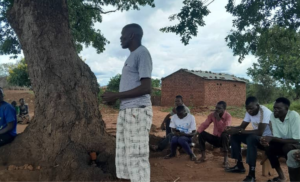
Patitana Mwanza’s hands have worked the Kasenengwa soil for over two decades. A father of five, grandfather of four, and the vice-headman of his village, his day-to-day life has, for as long as he can remember, been decided by the seasons, the yield of his fields and the needs of his community
For years, Patitana has lived as a farmer amongst farmers, tending to his fields, learning and doing his part to encourage his neighbours and share his knowledge. But recently, he has seen the foundation of his farming community begin to shift.
The rains, once a reliable visitor at the start of every October, have been hesitant and unpredictable, many times delaying until January. The impact has been gravely felt. The usually productive but traditional ways of farming on ridges have failed to hold against the changing climate and eroding soils, while chemical fertilisers strain their already limited profits and soils.
“As a leader of my community who understands that good soil is very important for us to get money and food, this was very stressful. We needed a plan to keep the soil good so that even our grandchildren would find the soil fertile,” Patitana recounts, sharing the journey of his community’s transformation with us.
The first turning point came in 2017 when Grassroots Trust, led by Seb Scott and Rolf Shenton, introduced pigeon peas to the community. Patitana, respected for his willingness to serve his community, was selected to guide ten other farmers in a pilot to improve not just soil but the community’s food security as well. Making sure that the pilot was framed as the partnership it was rather than a handout, Seb and Rolf offered critical guidance on how to grow pigeon peas and where to find a market. When others eventually moved on, Patitana persevered with the new crop, excited to see where the new practice would lead. This marked the beginning of a great friendship and mentorship between Patitana and Grassroots Trust.
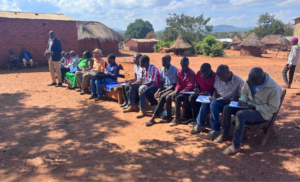
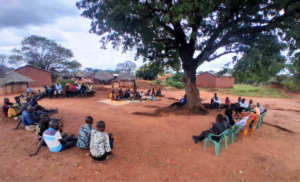
In 2021, Seb returned to Kasenengwa with another proposition: to establish a living classroom in the fields themselves. From the community, only Patitana and one other farmer from the village, Joshua, were selected to host the first schools. They started with just two sites, focusing on the art of compost making and strategically planting fertiliser trees like Faidherbia albida to anchor and nourish the depleted soils. The lessons were simple and inexpensive: “We just used compost manure. These animal manures, like cow manure and chicken manure, are better than artificial manures,” Patitana explains.
This knowledge, simple but powerful, soon began to spread across the community. By the next season, the number of field schools doubled from two to four, with Patitana helping to set up a new one in a nearby village. It soon became excitingly clear that the farmers were not just learning; they were becoming teachers themselves!
In March 2025, the community’s next chapter arrived in the form of Tweende. For this collaborative initiative, Grassroots Trust teamed up with the Zambia Alliance for Agroecology and Biodiversity and Mulungushi University to establish an agroecology centre of excellence in Kasenengwa. Building on the foundation that Seb and Rolf had already set in Patitana and neighbouring villages with their field schools, Tweende’s goal was to introduce a research and evidence-building element to the work. There was also a very apparent need to set up a seed bank in the community, with many farmers citing access to quality, adaptable, local seed as a recurring challenge in their efforts to adopt more ecological farming methods.
For Patitana, Tweende meant mobilising his village and two neighbouring ones around a new shared vision. To set up poultry schools for exchanging practical knowledge on not just how to raise a healthy brood, but how to do so inexpensively and profitably. Especially urgent was finding a solution to their biggest constraint when it came to poultry farming: the crushing cost of feed. “Feed is a problem. The cost is too high,” Patitana explains.
The goal was to become self-sufficient and learn how to grow and formulate their own feed. But the vision was not without resistance; when farmers were asked to form groups and contribute to building a new type of chicken coop, scepticism was high. “Ah, we can’t do it; we don’t have money,” many said. But as the deadline loomed, a determined group, led by Patitana, chose to act. “We decided, let us contribute money so that we can buy bricks and build,” he recalls.
And so each member gave ZMW50, buying bricks and raising the structure with their own hands.
What followed was a wave of innovation and activity, with, notably, Seb introducing a method to train chicks without an expensive brooder by creating a “bedroom” and “dining room” for them. “We taught those chicks, and they learnt. By 18 hrs every day (6pm), all the chicks would enter that bedroom to sleep,” Patitana recalls with pride and laughter in his voice.
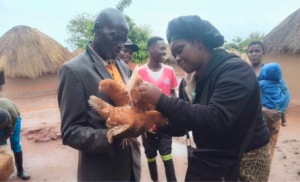
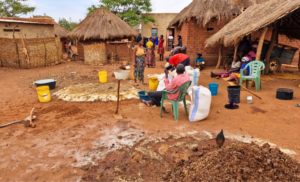
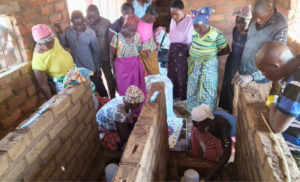
As for feed, they processed their own soybeans, using local presses and fuel-saving stoves to create nutritious, inexpensive food for the brood. The poultry pens soon became open-air classrooms in accounting and biology, and the end result was undeniable: of the 100 broilers they started with, 99 thrived and were sold, raising approximately ZMW11,800 for the group! Soon after, the group built a second, larger structure for layers, securing a steady source of eggs and income and closing the cycle: some of their crops feed the chickens, while the chickens’ manure enriches their soil.
For Patitana, the impact has been felt on both a personal and communal level. He has expanded on his natural leadership and evolved into a community architect, facilitating connections and knowledge and motivating his community to push for change together. Financially, his household has gained resilience through diversified streams of income from seed sales, poultry, and significant savings from homemade inputs. Socially, the village is reconnecting through collective action and shared purpose. Six active farmer groups now host demo plots, and plans for a community seed bank are underway. “The project that was once a dream at that time is now flying because what you taught us has been yielding something,” Patitana reflects.
The story of Kasenengwa is not about an outside organisation bringing change. Rather, it is the story of a community, guided by its own experiences and supported by loyal partnerships, deciding to take matters into their own hands to design the change they want. It is about Patitana and his neighbours looking at their land, their hands, and their future, and deciding together to grow something new from the ground up.