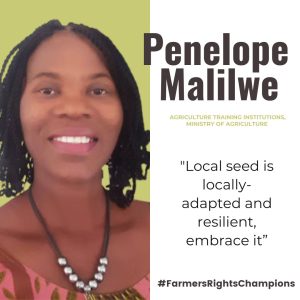
The Chief Coordinator for Agriculture Training Institutions at the Ministry of Agriculture, Penelope Malilwe, has a wealth of experience and a deep-rooted passion for agricultural development. Her journey in agriculture began with her training as a development specialist, and her work with agriculture colleges has further fueled her fascination with the subject. Penelope sees agriculture not just as a profession but as a boundless field of opportunity and discovery, constantly evolving and offering solutions to diverse challenges.
We spoke with the Farmers’ Rights Champion to understand the complexities of seed control within Zambia’s framework and explore solutions for local seed security.
How do you believe the proposed changes to the Zambian seed laws will impact farmers, especially those in remote or marginalised areas?
While the proposed changes to the seed laws hold promise, there are concerns that demand further exploration. It’s crucial to engage farmers extensively in the decision-making process to ensure that the reforms truly benefit them. Additionally, certain fees associated with seed testing could pose significant challenges for small-scale farmers, hindering their ability to access quality seeds.
In your opinion, what are the key challenges that Zambian farmers currently face regarding access to seeds, and do you think the proposed changes address these challenges?
Despite government subsidies on agricultural inputs, many farmers, particularly those in marginalised communities, still struggle to afford seeds. Furthermore, the reliance on external suppliers often leaves farmers vulnerable to delays and uncertainties, disrupting their agricultural activities. The proliferation of herbicides further compounds these challenges, jeopardising traditional seed varieties and exacerbating food insecurity in rural areas.
How do you envision the role of local communities and small-scale farmers in shaping agricultural policies, particularly those related to seed laws?
Small-scale farmers are the backbone of Zambia’s agricultural sector, contributing significantly to the nation’s food security. As such, they must play a central role in shaping agricultural policies, with their voices representing the majority. Collaborative research and consultations are essential to ensuring that policies reflect the realities and needs of farmers on the ground, mitigating the adverse effects of herbicides, and promoting sustainable farming practices.
Can you share a specific experience or example that highlights the importance of preserving traditional seed varieties in Zambia?
During a visit to my grandmother’s village, I witnessed firsthand the dwindling availability of traditional vegetables due to herbicide use. This loss of biodiversity not only threatens local diets but also undermines farmers’ resilience to environmental challenges. Preserving traditional seed varieties is paramount to safeguarding our agricultural heritage and ensuring food sovereignty for future generations.
What strategies do you think could be effective in ensuring that the proposed changes lead to positive outcomes for both farmers and the agricultural sector as a whole?
A comprehensive approach involving all stakeholders is essential to monitoring and evaluating the impact of the proposed changes. By fostering collaboration between the government, NGOs, and the private sector, we can develop inclusive strategies that prioritise farmers’ needs and promote sustainable agricultural practices.
Are there any specific concerns or considerations related to environmental sustainability that you believe should be taken into account in the context of the proposed seed law changes?
Given the escalating challenges posed by climate change, it is imperative to integrate agroecological practices into seed law reforms. By prioritising drought and disease-resistant seeds and minimising reliance on synthetic chemicals, we can enhance the resilience of our agricultural systems and mitigate environmental risks.
How can the government, NGOs, and the private sector collaborate to ensure that these changes promote inclusivity and benefit all stakeholders in the agricultural value chain?
Collaborative research and development initiatives that involve both public and private stakeholders are key to ensuring inclusivity and equity in the agricultural value chain. By leveraging collective expertise and resources, we can develop holistic solutions that address the diverse needs of farmers and promote sustainable agricultural development.
Could you provide a personal statement or quote expressing your thoughts and concerns about the proposed changes to Zambian seed laws, which can be shared as part of our campaign?
“Local seed is not just our inheritance; it’s our resistance to climate change. Embracing locally-adapted and resilient seeds is not only a safeguard for our agricultural future but also a testament to our commitment to sustainable farming practices.”